

You have two or three quotes on the desk for the same job, and on paper they look close. The gap is rarely the number at the bottom. It is what sits behind it, and a few plain questions tell you which contractor you can actually rely on.

Compare what sits behind the price, not just the price.
Check six things in any quote: is it fixed and itemised, is public liability insurance confirmed, are technicians DBS-checked, can they work out of hours and dry quickly, is the invoicing clean to a business account, and is there a written guarantee if a result is not right.

Jump to a section
Is the quote fixed and itemised?
Is public liability insurance confirmed?
Are the technicians DBS-checked?
Can they work around your hours?
Is the invoicing clean and documented?
Is there a written guarantee?
Our commercial process
These are not questions about us. They are questions worth asking any contractor before you sign, and where a good answer holds, you have found a good supplier.
Is the Quote Fixed and Itemised?
The first thing to look for is not the total. It is how the total was built.
A fixed, itemised quote lists what is included: the areas, the treatments, the number of visits, and anything that would cost extra. You can read it, sign it off, and know that the figure at the bottom is the figure you will be invoiced. Two itemised quotes can be compared line by line.
A vague day rate is harder to trust. It leaves the final figure open, depends on how long the day runs, and often lands higher than expected once the work is done. If a quote does not tell you what you are actually paying for, ask for it in writing before you decide.
What to Watch for in a Quote
None of these mean a contractor is dishonest. They mean the quote is worth a second question before you sign.
- A single day rate with no breakdown of the work
- No mention of insurance cover anywhere in writing
- No clear answer on who will actually attend site
- No plan for how the floors will be dry before you open
- Cash only, or an invoice that will not go to your business account
- No written guarantee if the result is not right
Is Public Liability Insurance Confirmed?
On a premises with staff, stock, or the public, this is the one you cannot skip.
Cleaning work moves furniture, runs water and equipment, and takes place around people. If something is damaged, the contractor’s public liability insurance is what covers it, not yours. A facilities manager should expect to see that cover confirmed in writing, not simply mentioned on a call.
The question is a simple one to ask, and a straight answer tells you a lot. A professional contractor will confirm they are fully insured and be happy to put it in writing. If the answer is vague, that is worth noting before the work reaches your floor.
Are the Technicians DBS-Checked?
If your premises has staff, residents, or members of the public, ask who is coming through the door.
Cleaning happens inside your building, sometimes after hours, sometimes near vulnerable people or valuable stock. DBS-checked technicians are worth confirming for any premises where people are present. It is a fair thing to ask, and any professional contractor will answer it plainly.
It is not only about the check itself. It is about who actually turns up. Ask whether the same, vetted people attend each visit, or whether the work is passed to whoever is available on the day. Consistency on site is part of what you are paying for.
Worth a Second Question
- No clear answer on who attends site
- Different people every visit
- Checks mentioned but not confirmed
What to Expect
- DBS-checked technicians confirmed plainly
- The same trusted people on each visit
- Fully insured, on a staffed line, not a personal mobile
Weighing Up Contractors?
Tell us about the premises, the areas and the hours you need covered, and we will send a fixed, itemised written quote you can compare against any other. Take your time deciding.
Can They Work Around Your Hours?
The best clean is worth little if it closes you down or leaves wet floors at opening.
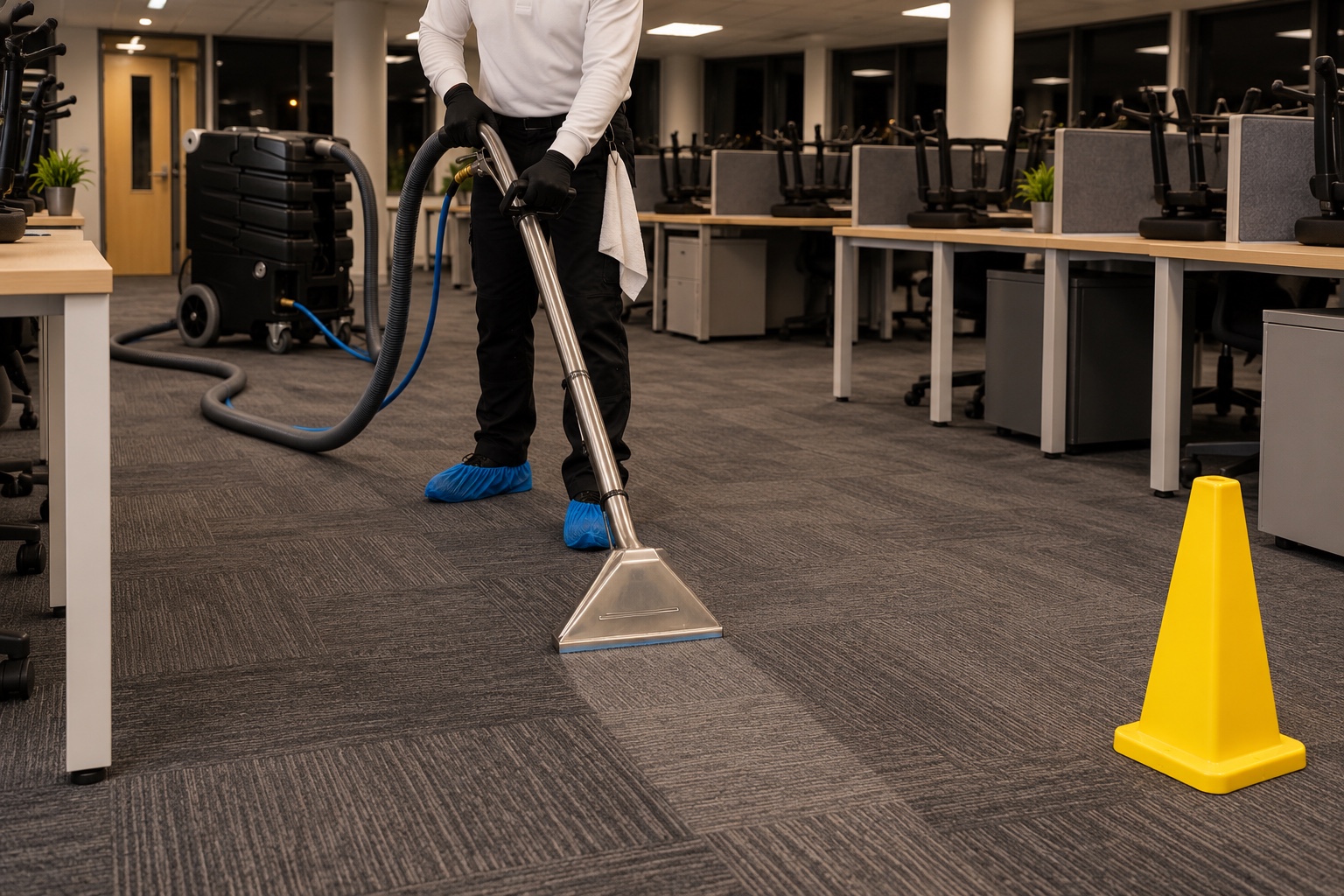
Method and equipment matter here as much as price. Ask whether the contractor is set up for evening or overnight visits, and how quickly the floors will be dry. A supplier geared for commercial work plans the visit around your trading hours, so staff and customers arrive to a clean, dry floor rather than a cordoned-off area.
Drying is the part that catches people out. A clean that leaves carpet damp into the morning is a slip risk and a disruption. We use controlled moisture and strong extraction so areas dry quickly, usually within a few hours, and where timing is tight we plan the schedule so you open onto dry floors.
A contractor set up for commercial work will schedule around your hours and tell you plainly when the area will be dry. If a quote has no plan for drying, that is worth raising before you sign, because wet floors at opening are nobody’s idea of a clean start.
Is the Invoicing Clean and Documented?
For a business, how you are billed matters as much as what you are billed.
A professional supplier invoices cleanly to your business account, with a clear reference for what was done and when. That paperwork is what your finance team needs, what your records need, and what a proper supplier relationship runs on. Cash-in-hand arrangements make all of that harder.
Ask how you will be invoiced before the work is booked. A contractor set up for commercial clients will have a straightforward answer: a written quote first, then a clear invoice to your account, with everything documented. That is the difference between a one-off favour and a supplier you can rely on.

Is There a Written Guarantee?
The last thing to check is what happens if a result is not right. On a commercial job, that answer should be in writing, not a promise on a call.
Our position is straightforward: if you are not satisfied with the clean, we come back free of charge until you are. It is a guarantee put in writing, so you know exactly where you stand before the work begins, and so do we.
Compare quotes on what sits behind the number: fixed and itemised, fully insured, DBS-checked, set up for your hours, cleanly invoiced, and guaranteed in writing. Whichever contractor answers those six well is the one worth signing.
Our Commercial Cleaning Process
It is not one step. It is a simple sequence built to keep your premises open and your floors ready when you are.
Survey & QuoteWe inspect the areas, spot-test where needed, and send a fixed, itemised written quote before anything is booked.
Work Your HoursWe schedule around your trading times, out of hours where it matters, so the premises stays open.
Deep Clean & DryHot water extraction with controlled moisture, so areas dry quickly and you open onto dry floors.
Document & InvoiceWe finish, leave the standard we promised, and invoice cleanly to your business account.
Why Prestige Refresh
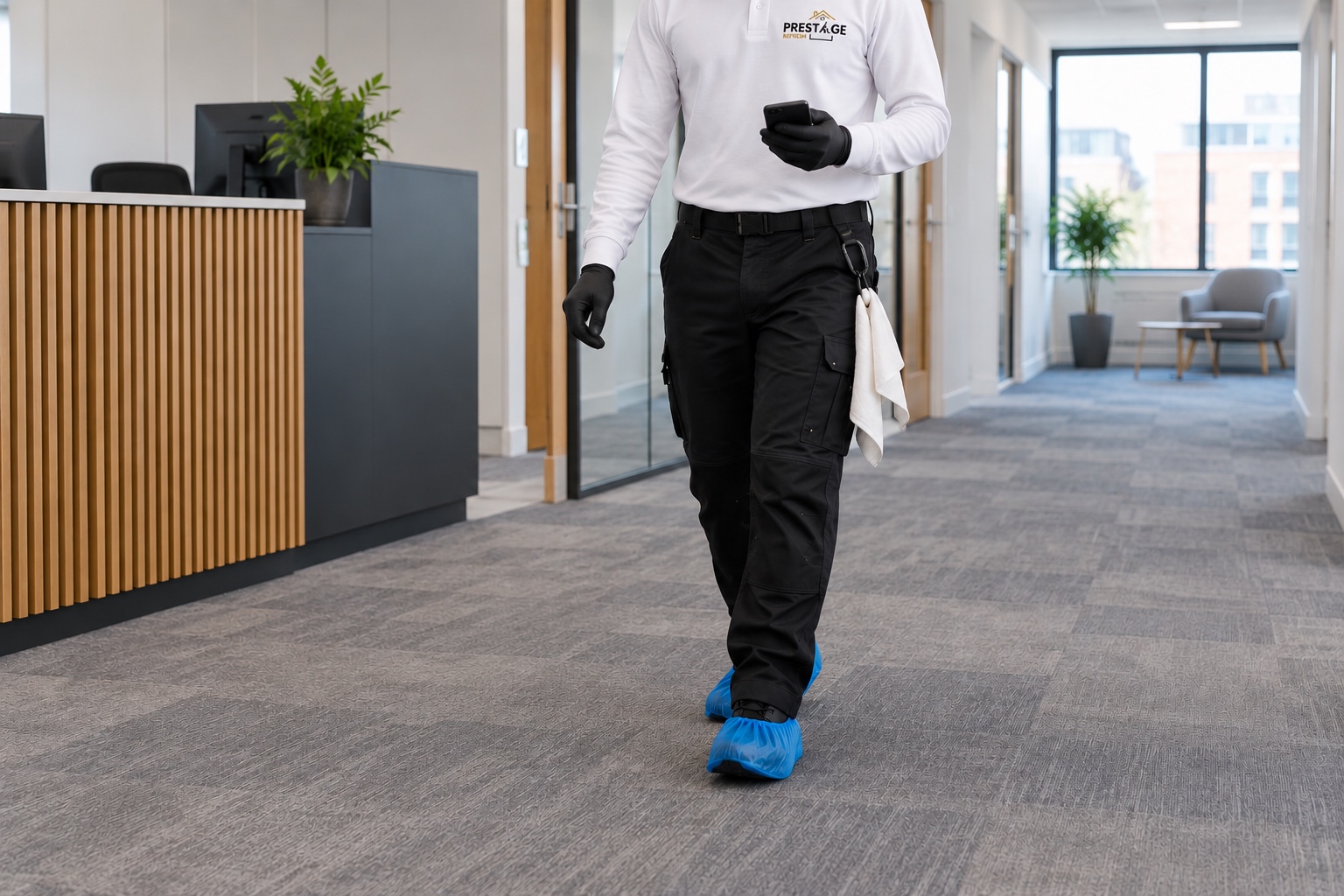
When commercial clients tell us why they chose us, the same four reasons come up. They are the standard we hold every job to.
If you want to keep a premises at a steady standard through the year, ask about Spread the Clean, our commercial plan that spreads the cleaning across the year rather than booking it in ad hoc. It is offered plainly, and you get the same work and the same guarantee either way.
What Customers Say
We could tell you we are set up for commercial work. It means more coming from the people we have actually cleaned for. We are rated 5.0 from 338 Google reviews, and these come straight from them, unedited.
Our Golden Guarantee
The Golden Guarantee
We quote clearly, work cleanly, and document properly. A written quote before we start, and a re-clean promise in writing after, backed on every commercial job.
Quick Answers
What should I check in a commercial cleaning quote?
Check that the quote is fixed and itemised rather than a vague day rate, that public liability insurance is confirmed in writing, that the technicians are DBS-checked, that the contractor can work out of hours and dry quickly, that the invoicing is clean and to a business account, and that there is a written guarantee if a result is not right.
Should a commercial cleaning quote be itemised or a day rate?
A fixed, itemised quote is clearer to compare and easier to sign off. It tells you what is covered, what is not, and what you will be invoiced. A vague day rate leaves the final figure open and makes two contractors hard to compare like for like.
Do commercial cleaners need to be DBS-checked?
For premises with staff, residents or members of the public, DBS-checked technicians are worth confirming. Ask any contractor plainly whether the people attending site are DBS-checked, and expect a straight answer.
Why does out-of-hours cleaning matter for a business?
Cleaning around your hours keeps the premises open and avoids wet floors when staff or customers arrive. Ask whether the contractor is set up for evening or overnight visits and how quickly the floors will be dry, so you are not opening onto damp carpet.